
TSH "Within Range" but Still Exhausted? Understanding Optimal vs. Normal Thyroid Levels

You finally went in because you were exhausted — dragging through the day, foggy, maybe gaining weight or feeling cold and low. Your provider ran a thyroid test, the results came back, and you heard the familiar words: "Your thyroid is normal. Everything looks fine."
Except you don't feel fine. And now you're left wondering whether it's all in your head.
It isn't. One of the most common and frustrating experiences in thyroid care is being told your labs are "normal" while your body is clearly telling you something is off. Very often, the missing piece is the difference between a thyroid level that's technically normal and one that's actually optimal for you. Understanding that distinction can change everything.
Where the "normal" range actually comes from
Here's something most people are never told: the "normal" range on your lab report isn't a marker of ideal health. It's a statistical range, built by testing a large group of people and defining "normal" as wherever most of them fall.
The catch is that the general population used to build those ranges isn't necessarily a healthy population. It includes plenty of people with undiagnosed or developing thyroid problems. So the range ends up wide — and simply landing somewhere inside it doesn't mean your thyroid is functioning at its best. It mostly means you're not far enough outside the average to trigger an automatic flag.
In other words, "not flagged" and "optimal" are two very different things. You can fall inside the normal range and still feel genuinely unwell.
TSH: the number that gets over-trusted
Most standard thyroid screening leans heavily on a single number: TSH, or thyroid-stimulating hormone. And TSH is useful — but it's widely misunderstood.
TSH isn't actually a thyroid hormone. It's a message from your brain telling your thyroid how hard to work. A high TSH generally means your brain is shouting for more thyroid hormone; a lower TSH means it's satisfied. Because it's an indirect signal, TSH alone can miss a lot — especially in the earlier or subtler stages where you feel the symptoms but the number hasn't drifted dramatically yet.
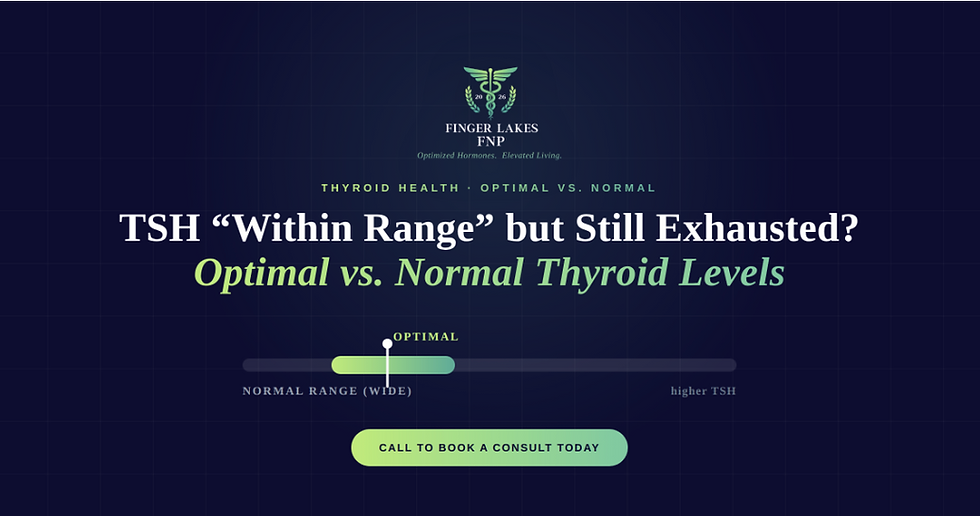
This is why so many exhausted people get waved through. Their TSH sits at, say, 3 or 4 — technically inside the standard range — and the conversation ends there, even though many people feel and function best when their TSH is lower, often closer to the 1 to 2 range. That gap between "inside the range" and "where you actually feel well" is exactly where people get stuck for years.
The tests that tell the fuller story
Optimizing a thyroid means looking beyond that single signal to see how your thyroid is truly functioning.
That means also measuring the actual thyroid hormones your body uses — particularly Free T3, the active form your cells run on, and Free T4, the reserve form your body converts into T3. Someone can have a "fine" TSH but still be low or poorly converting on these active hormones, which shows up as symptoms. When the picture is confusing, additional tests like Reverse T3 can reveal when your body is essentially braking its own thyroid function, and thyroid antibodies can uncover Hashimoto's — an autoimmune process that's one of the most common and most missed reasons thyroid function quietly declines.
Read together and against how you actually feel, these paint a far more useful picture than a lone TSH ever could.
Treat the person, not the number
The principle at the heart of all this is simple: we treat the patient, not just the lab value.
A number on a report doesn't feel your fatigue, your brain fog, or your cold hands. You do. When your symptoms clearly point toward an underactive thyroid, that deserves a real evaluation and an honest conversation — not a dismissal because one value technically fell inside a wide statistical band. Your symptoms aren't background noise to the labs; they're a central part of the diagnosis.
This doesn't mean chasing arbitrary numbers or medicating everyone. It means reading your labs in the context of you — your symptoms, your history, and how you actually feel day to day — and aiming for genuinely optimal function rather than settling for "not flagged."
Why this matters for how you feel
When thyroid function is truly optimized rather than just nudged inside a range, the difference can be striking: steadier energy, a clearer head, more stable mood, easier weight management, and simply feeling like yourself again.
Getting there usually isn't just about a prescription, either. Thyroid health is supported by the right nutrients, good sleep, managed stress, and addressing any autoimmune activity — and when medication is appropriate, there are several options, with the right one depending on your labs, symptoms, and how your body responds. The goal throughout is the same: not to move a number a little, but to help you feel well.
If you've been told you're "fine" but you don't feel fine
Please trust what your body is telling you. If you're exhausted and running on empty while your thyroid labs have been called "normal," you deserve a closer, more complete look — one that considers optimal ranges, the full thyroid picture, and your actual symptoms.
At Finger Lakes FNP, this is exactly how we approach thyroid care: comprehensive testing, an eye on optimal (not just normal) function, and treatment built around the whole person rather than a single value on a page.
Call to book a consult today (607) 638-2492, and let's find out why you've been feeling this way — and what we can do about it.
-Melissa Vorhis, DNP, FNP-C
This article is for educational purposes only and is not a substitute for individualized medical advice. Thyroid evaluation and treatment require proper testing and monitoring with a qualified provider, and "optimal" targets vary from person to person. Please consult us or your healthcare provider before making any changes to your care.


Comments